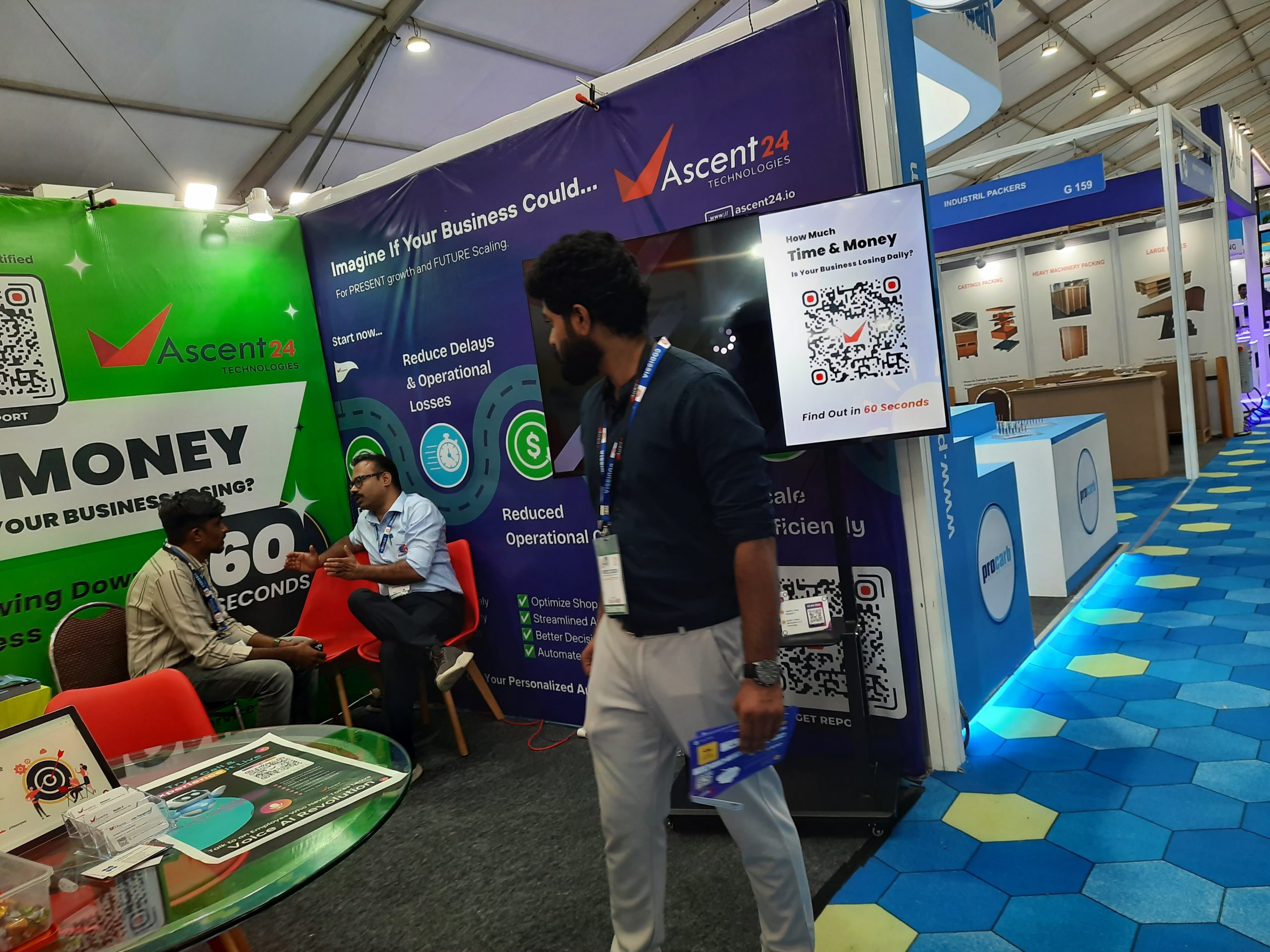
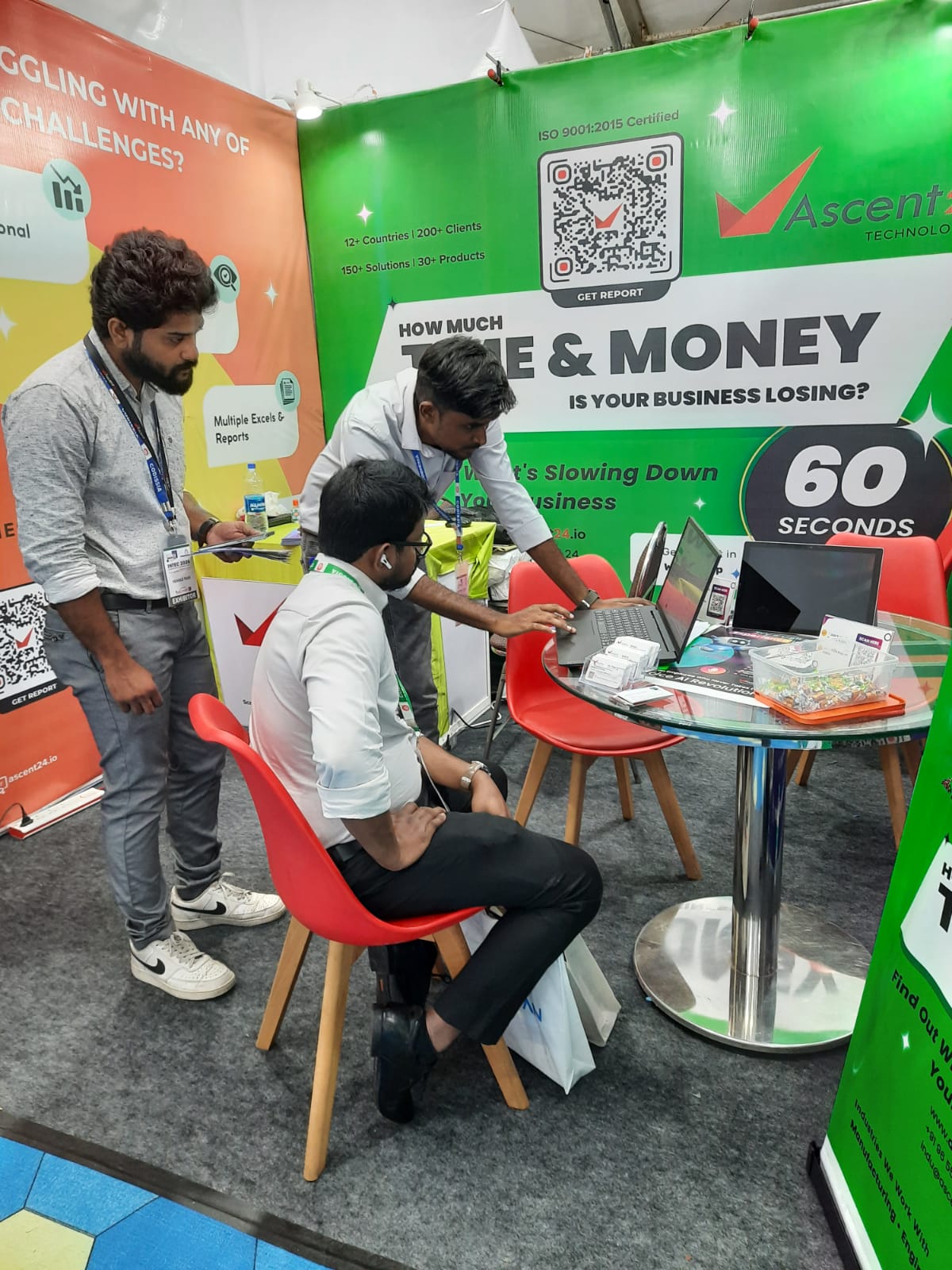
Over five days at Stall G161, hundreds of Indian manufacturers walked up and shared their biggest operational challenges. Industries were different. Workforce were different. Even workflows and place of business were different. Yet, same seven problems kept coming up. Here’s exactly what they were, and what we told each one.
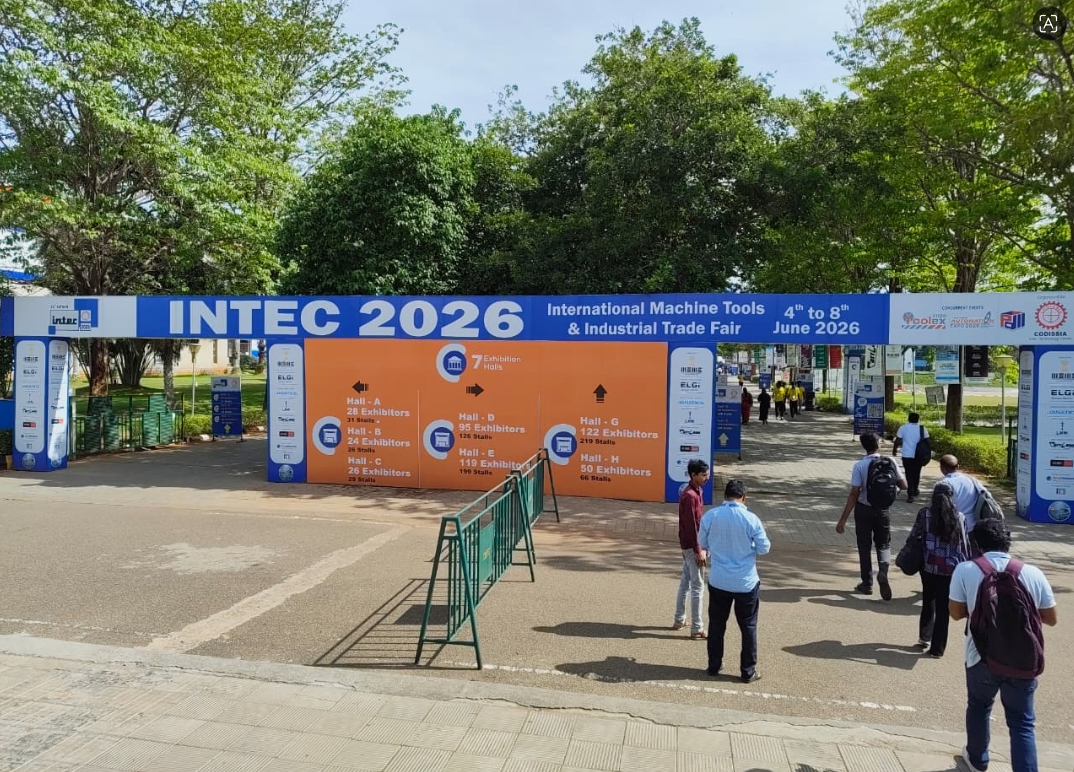
“We didn’t go to INTEC 2026 to pitch. We went to listen. And what we heard from hundreds of Indian manufacturers told us everything about where Indian industry stands in 2026, and exactly where the gaps are.”
Five days. Stall G161. Hundreds of conversations. First day, though was energetic, it felt like we were thrown between multiple industries. We got the opportunity to speak with multiple manufacturers, business owners, head of departments looking for better solutions to support their team and reduce their team’s workforce.
Though hearing everything appeared like it was first time, every single time, by Day 2, a clear pattern had emerged: despite differences in industry, geography, scale, and product, the manufacturers walking into our stall were carrying the same seven problems.
A gear motors manufacturer from Coimbatore. A CNC manufacturing company from Bengaluru. A textile manufacturer from Tirupur. Even a Coffee Plantation owner from Chikkamagalur. A paint manufacturing company from Calicut. An auto-component supplier from Chennai. Different businesses, same pain.
Here are the seven problems we heard most, and the honest suggestion we gave to every manufacturer who brought them to us.
This was the single most repeated sentence at our stall across all five days. The exact wording changed. Sometimes it was “I only find out about problems the next morning,” sometimes it was “my production manager gives me updates on WhatsApp”, sometimes, “I’m not able to see who is working on which batch of product”, sometimes, “I’m not able to identify what went wrong”, but the underlying issue was identical: zero real-time visibility into their own operations.
These weren’t small factories. We heard this from owners running 200-person operations, from plant heads managing three-shift facilities, from CEOs overseeing multiple locations. The majority of Indian manufacturers in 2026 are still running on delayed data. End-of-shift reports, morning meetings, Excel files forwarded at 9 PM, post the team has left for the day.
What we told them: A live production dashboard connected to your shop floor, tracking output, downtime, and quality in real time can be operational in weeks, not months. The first time you see a production shortfall developing mid-shift and correct it before the shift ends, the ROI conversation is over. Start with one line, one shift. Prove it. Expand from there.
The second most common complaint and the one that generated the most visible frustration. Manufacturers described the same scene from inventory in different words: “The unused stocks remain piling up while the fast-running stocks are hard to identify and have them restocked before it runs out.”, “A customer order gets confirmed, production starts, and three days in, someone discovers the raw material was never actually in stock.”, the worst, “The system shows 400 units of a component is available in warehouse but the actual count is 187.”
Inventory inaccuracy in Indian manufacturing is not a warehousing problem. It is a data problem. Manual entry, delayed updates, no threshold limit, no bin-level tracking, and disconnected procurement and production systems combine to create a permanent gap between what the system says and what’s actually on the shelf.
What we told them: The fix is not a bigger warehouse team. It is a connected inventory system where every material movement is logged at the point it happens, not at the end of the day. Barcode scanning, mobile entry at goods receipt, and automated consumption deduction from BOMs can bring inventory accuracy from 60% to 98% within one production cycle. Not jsut demo, we even displayed them how it might appear in their dashboard, in mobile app!
This one arrived with a particular edge. The frustration of a business owner who suspects the reports they’re receiving are inaccurate but has no way to verify them. Excel-based reporting in Indian manufacturing creates a specific cultural problem: when data can be manually edited by anyone, the integrity of every report becomes questionable. And when numbers are questioned, decision-making slows down.
We met manufacturers whose entire production planning, costing, inventory, and dispatch operations ran across a series of Excel files maintained by different people, in different formats, updated at different times. The reconciliation effort alone was consuming 8–12 hours of management time per week.
What we told them: The goal isn’t to ban Excel. It’s to remove Excel from the data-capture layer. When transactions happen in a system (not a spreadsheet), the numbers are timestamped, attributed, and immutable. Excel can still be used for analysis. It should never be the system of record. The transition is less disruptive than most manufacturers expect, especially when done module by module.
A rising rejection rate with no clear root cause. This problem came from across sectors. Garment units with increasing export re-inspection rates. Precision shops with growing scrap percentages. Auto-component suppliers whose customer complaint rates were creeping up quarter by quarter. In every case, the quality data existed, “somewhere, in some register”, but was not being analysed in a way that revealed the pattern.
The issue is not a lack of quality consciousness. Indian manufacturers, particularly those supplying export customers or Tier-1 OEMs, take quality seriously. The issue is that manual quality logging doesn’t reveal trends fast enough to act on them before they compound.
What we told them: Digital quality logs with rejection reason codes, linked to machine, operator, shift, and batch, turn a problem that takes months to diagnose into one that takes days. When you can see that 73% of rejections on a specific component happen on the night shift, on one machine, that’s an actionable insight. Paper registers can never give you that. A QMS can, within weeks of go-live.
Delivery performance anxiety was everywhere at INTEC 2026. Manufacturers described the same cycle: a committed delivery date, a production shortfall mid-cycle, a frantic call to the customer on the night before the promised date of dispatch, a discount offered as compensation and a relationship that gets a little more fragile every time. For export-oriented and raw material suppliers in particular, this was described as an existential problem: miss enough shipment windows and you don’t get another chance.
The root cause is almost always the same: delivery commitments are made without live production data to back them up. Sales commits based on historical averages. Production encounters a real-world problem. The customer pays the price.
What we told them: On-time delivery improves when sales and production share the same live system. When a sales person can see actual production capacity before committing a delivery dat, not a theoretical capacity, but today’s actual available capacity, the commitment is realistic from the start. A connected sales-to-production system is the single most impactful change a delivery-challenged manufacturer can make.
A specific version of the visibility problem that was prevalent among the more established manufacturers at INTEC. Businesses that had grown from one plant to two or three, but whose systems had not kept pace with their geographic expansion. Each plant operating as an information island. Inventory mismatches between locations. No cross-plant production benchmarking. The CEO finding out about problems at Plant 2 via the Plant 1 manager’s WhatsApp. We even heard a situation where the CEO was not even aware of the accident to one of their trucks carrying goods, until next day morning.
What we told them: Multi-plant visibility is not a luxury for large corporations. A unified production and inventory system across all locations, accessible from one login, from any device, is achievable at SME investment levels in 2026. The manufacturers who build this infrastructure now are the ones who can open a fourth plant without tripling their management overhead.
This was the most emotionally charged problem we encountered and possibly the most important. A significant number of manufacturers at INTEC had already attempted a software implementation: a generic ERP purchase that was never fully adopted, a SaaS product that didn’t fit their workflow, a system that the team used for three months and then abandoned. The financial and emotional cost of those failures had made them deeply sceptical of trying again.
This scepticism is entirely rational. Generic software fails Indian manufacturers not because the manufacturers are unsophisticated, but because the software was built for a different operational reality. A system designed for Western manufacturing workflows does not account for Indian GST complexity, job-based production patterns, multi-shift operations, or the realities of manual-digital hybrid environments.
What we told them: The previous failure wasn’t yours. It was the software’s. Custom software built around your specific workflow, your team’s habits, and your industry’s realities doesn’t require your operations to adapt to the system. The system adapts to you. That’s the difference between a generic product and a custom solution, and it’s the difference between an abandoned system and one your team actually uses, every day, three years later.
Every single problem on this list, from real-time visibility to multi-plant management to failed software implementations, has the same root cause: Indian manufacturers are trying to run modern operations with information infrastructure that was never designed for scale. The good news is that in 2026, every one of these problems has a specific, affordable, custom-built solution. We spent five days at INTEC 2026 proving exactly that.
Still Have One of These Problems?
Let’s Solve It.If you visited us at INTEC 2026 and are ready to take the next step, or if you missed the event and recognise your factory in any of the seven problems above, our team is ready to find the best-fit solution for your business.
Ascent24 Technologies builds custom manufacturing software for Indian businesses. Not generic packages. Not one-size-fits-all templates. Software built around your workflow, your team, and your growth goals, by a team that understands Indian manufacturing from the inside.
Let’s Discuss Solutions →Ascent24 Technologies · Coimbatore · ISO 9001:2015 Certified · Custom Software & Digital Transformation for Indian Manufacturing