Many travel businesses start with a plugin, a white-label widget or a set of enquiry forms backed by email and spreadsheets. But as product lines, suppliers and sales channels multiply, those tools start to limit what you can sell and how quickly you can sell it. This guide walks through what a modern booking engine needs to do, the integrations that matter most, and how to approach building one without overspending.
What a booking engine actually does
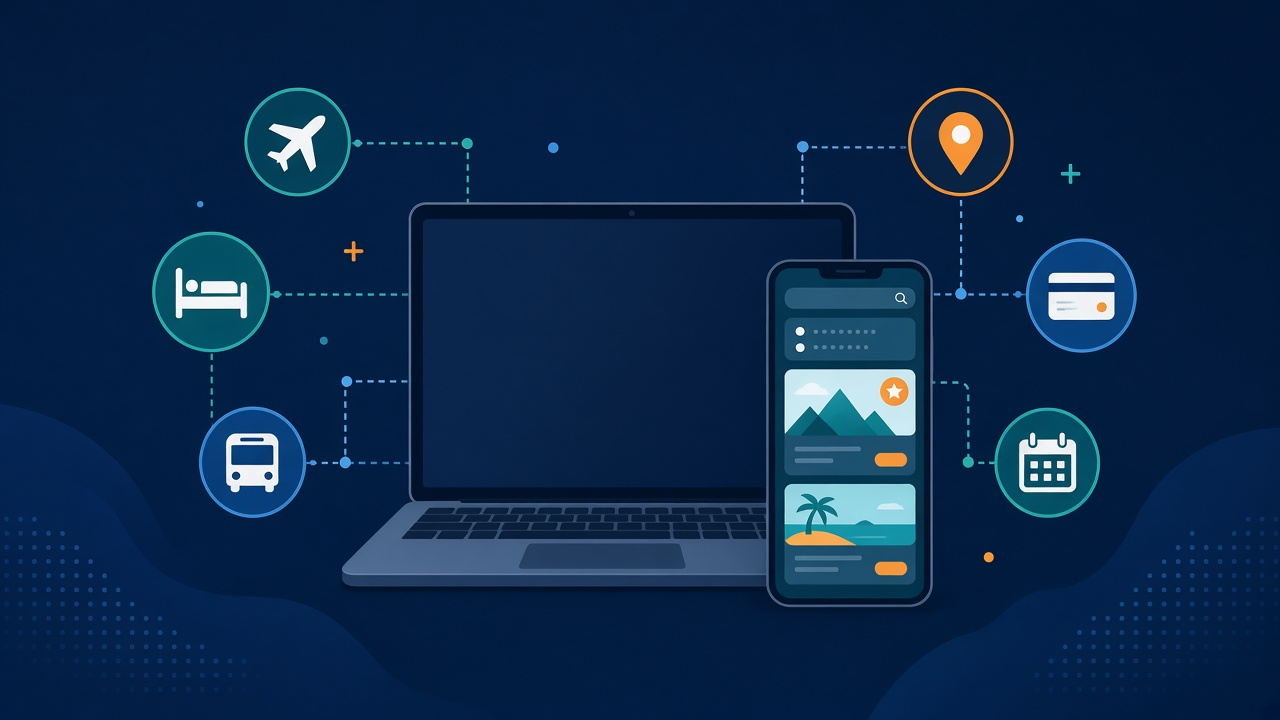
At its simplest, a booking engine lets a customer search for a product, see live availability and price, choose options, pay and receive confirmation. Behind that simple flow sit several jobs that must run reliably:
- Inventory and availability: knowing in real time how many seats, rooms, slots or departures are left, whether they come from your own stock or from a supplier.
- Pricing and rules: seasonal rates, child and group pricing, early-bird offers, promo codes, markups on supplier rates and currency conversion.
- Booking and holds: temporarily holding inventory while the customer pays, then confirming or releasing it cleanly.
- Payments: taking full payments or deposits, handling refunds and cancellations, and keeping records your finance team can reconcile.
- Confirmation and documents: vouchers, itineraries and invoices sent automatically by email or messaging.
- Back-office control: a dashboard where your team can manage products, see bookings, update allocations and handle changes.
If any one of these is handled manually, it becomes the bottleneck as volume grows.
The integrations that make or break it
Most travel businesses do not own all the inventory they sell. That makes integrations the most important, and often the most underestimated, part of a booking engine project.
Supplier and aggregator APIs. Hotels, activities, transfers and flights are commonly sourced through supplier APIs, bed banks, channel managers or global distribution systems. Each has its own formats, rate limits and booking flow. A good engine normalises these into one internal model so your website and team see a consistent product, regardless of where it comes from.
Payment gateways. You may need more than one gateway to support different currencies, regions or payment methods, plus support for deposits, balance payments and partial refunds.
CRM and marketing tools. Passing booking and customer data into your CRM lets you follow up on abandoned searches, send pre-trip information and run repeat-customer campaigns.
Accounting and ERP. Bookings, supplier costs and payments should flow into your accounting system rather than being re-keyed, which reduces errors and saves time at month end.
B2B and agent channels. If you sell through sub-agents or corporate clients, the engine may need agent logins, credit limits, commission rules and separate rate sheets.
When planning, list every system the engine must talk to and rank them by business impact. That list usually shapes the timeline more than the user interface does.
Features worth prioritising
Not every feature belongs in the first release. These tend to deliver the most value early:
- Fast, accurate search. Customers expect results quickly. Caching supplier responses sensibly and showing clear availability builds trust.
- Mobile-first booking flow. Many travellers research and book on their phones, so the checkout must be short and easy to complete on a small screen.
- Flexible product modelling. Tours, packages, multi-day itineraries, add-ons and transfers rarely fit one template. The data model should handle them without workarounds.
- Clear cancellation and change handling. Policies should be visible before payment and enforced automatically afterwards.
- Operational dashboards. Your team should be able to see departures, manifests, payments due and supplier confirmations at a glance.
Extras such as dynamic packaging, loyalty programmes and AI-driven recommendations can follow once the core flow is stable.
Build, buy or combine?
There are three common paths. Ready-made booking platforms are quick to launch and work well when your products fit their model. A fully custom engine gives you complete control over products, pricing logic, integrations and user experience, which matters when your offering is your competitive edge. Many businesses choose a middle route: keep proven components such as payment gateways and channel managers, and build custom software around them to handle the parts that make the business different.
The right answer depends on how unusual your products are, how many suppliers you use, how much you rely on B2B channels and how fast you expect to grow.
Choosing the right technology
A booking engine needs to stay responsive during peak seasons and promotions. A cloud-hosted setup on AWS, Google Cloud or Azure allows the system to scale up when traffic rises and scale back when it falls. A modern front end built with React, Angular or Vue keeps search and checkout fast, while a backend in Node.js, Python or PHP handles pricing rules, supplier calls and bookings. If you also want a branded mobile app, a cross-platform framework such as Flutter lets you reach iOS and Android from one codebase.
Just as important are secure handling of payment and personal data, logging that traces failed supplier calls, and automated tests around pricing and availability.
A sensible way to get started
The most successful booking engine projects usually start small and focused:
- Begin with a discovery phase to document your products, suppliers, pricing rules and current pain points.
- Launch a first version covering your best-selling products and most important integrations.
- Measure how customers search and book, then expand to more suppliers, channels and features.
This approach gets a working engine in front of customers sooner and lets real behaviour, rather than assumptions, guide the next stage of investment.
Talk to Ascent24 about your booking engine
Ascent24 Technologies builds custom software, web and mobile apps, and cloud solutions for travel and tour businesses, including booking engines and supplier API integrations. Whether you are replacing a plugin you have outgrown or planning a new platform from scratch, our team can help you scope it, build it and scale it.
Share your requirements at ascent24.io or email us at info@ascent24.io, and our team will get back to you within 24 hours.