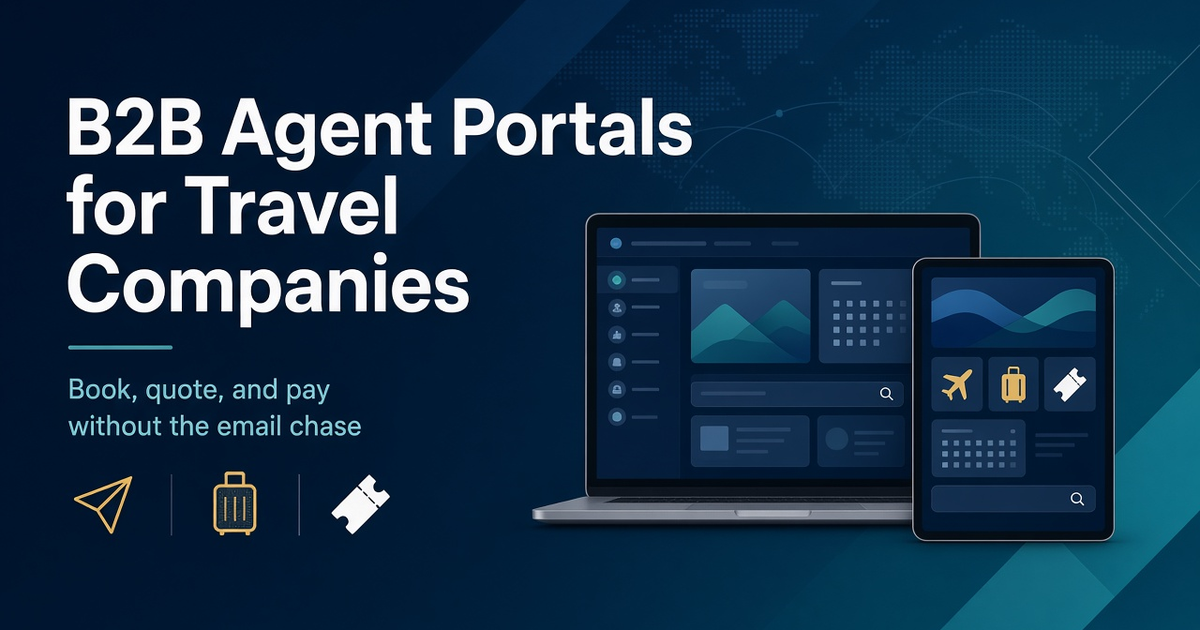
That works with a handful of partners. It breaks with dozens or hundreds, each with their own rates and credit terms. A B2B agent portal gives partners a self-service place to search, quote, book, and pay, while your team keeps control of pricing and inventory. Here is what such a portal should do, the integrations that matter, and how to roll it out safely.
Why email-driven partner bookings hold travel businesses back
The problems tend to show up in a few familiar places:
- Slow quotes. Every request waits for a person to check availability and price it, and agents often go to whoever responds first.
- Pricing mistakes. When markups and partner rates live in spreadsheets, wrong quotes are easy to make and hard to spot until margin is lost.
- Double handling. Details from an email are retyped into a reservation system and again into an invoice, inviting errors at each step.
- Little visibility. Partners cannot see booking status without asking, and managers cannot easily see which partners are growing or slow to pay.
None of this is a staffing problem. It is a systems problem.
What a practical B2B agent portal should include
Every travel business is different, but most effective portals share a core set of features.
Partner accounts and roles. Each agency gets its own account, with roles that decide who can book, see net rates, or manage payments.
Partner-specific pricing. Usually the heart of the system. The portal applies each partner's contract rates, markups, or commission rules automatically, and your team updates rules in one place instead of editing price sheets.
Live search and availability. Agents search tours, packages, hotels, transfers, or activities and see real availability from your inventory and supplier connections.
Quotes and itineraries. Agents can build a multi-day itinerary, save it as a quote for their customer, download a clean document, and convert it to a booking later.
Bookings and documents. Confirmed bookings generate references, vouchers, and invoices automatically, always available to download again.
Credit limits and payments. The portal tracks deposits, credit limits, or prepaid wallets, blocks bookings over limit, and accepts online payments where that suits you.
Amendments and cancellations. Agents request or make changes within your rules, with cancellation policies and fees applied consistently.
Reports for both sides. Partners see bookings and statements; your team sees volume, revenue, and margin by partner, product, and season.
Integrations that make or break the portal
A portal that does not talk to your other systems just moves the retyping elsewhere. Map where data needs to flow:
- Reservation or inventory system. Availability and bookings should sync with the system your operations team already uses.
- Supplier connections. If you resell supplier inventory, these decide how live your availability really is.
- Accounting or ERP. Invoices, receipts, and partner balances should sync so your accounts team is not reconciling by hand.
- Payment gateway. Card payments and wallet top-ups need clear handling of failed or partial payments.
- CRM and email. Partner details and notifications work best connected to the tools your sales team already uses.
Where an existing system has no usable API, the honest answer may be to plan a middle layer or a phased replacement rather than forcing a fragile connection.
Off-the-shelf platform or custom build?
Packaged B2B travel platforms can be a sensible start when your products and pricing rules match what the platform expects. A custom portal usually makes more sense when your pricing logic is complex, you mix your own products with supplier inventory, you need deep integration with an existing reservation or ERP system, or the partner experience is part of how you compete.
A phased way to roll it out
Launching everything at once is risky. A practical sequence:
- Pilot first. Pick a few trusted partners and your most-booked products.
- Core flow. Launch search, partner pricing, and booking, and get them right.
- Quotes, documents, and payments. Add itineraries, vouchers, and payment or credit handling.
- Finance and reporting. Sync invoices and balances with accounting and add management reports.
- Scale up. Onboard remaining partners in batches and keep improving from feedback.
Keep your email process running during the transition so no partner is left without a way to book.
Getting started
A B2B agent portal turns partner bookings from slow back-and-forth into a fast, consistent self-service channel, with better pricing control and a clearer view of the business. Start from your real workflows, plan integrations early, and roll out in steps.
Ascent24 builds custom web and mobile platforms for travel businesses, including booking engines, partner portals, and integrations with reservation, payment, and accounting systems. If you are planning a B2B portal or want to modernise how your partners book with you, get in touch with us at info@ascent24.io.