Why this choice matters more now
More developers now work outside traditional employment. In Stack Overflow's 2026 Developer Survey (30,903 valid responses from 169 countries, published 6 October 2026), 10.5% of respondents said their employer is "just me", meaning freelancers and sole proprietors, up from 3.9% a year earlier. Buyers have more options, and more ways to set them up badly.
The same survey shows why outside help often struggles: 63% of respondents said incomplete information blocks the context they need, and 61% said important context lives in people's heads. Outside developers feel that gap most.
The three models in plain terms
| Staff augmentation | Dedicated team | Project outsourcing | |
|---|---|---|---|
| Who runs daily work | You | Your product owner sets priorities, the vendor runs the team | The vendor |
| What you pay for | People's time | A stable team, usually monthly | An agreed scope or milestones |
| Best when | You have a team and process but lack capacity or a skill | Your roadmap runs for many months | Scope is clear and fairly stable |
| Main risk | Your leads get stretched | Weak product ownership on your side | Change requests and scope disputes |
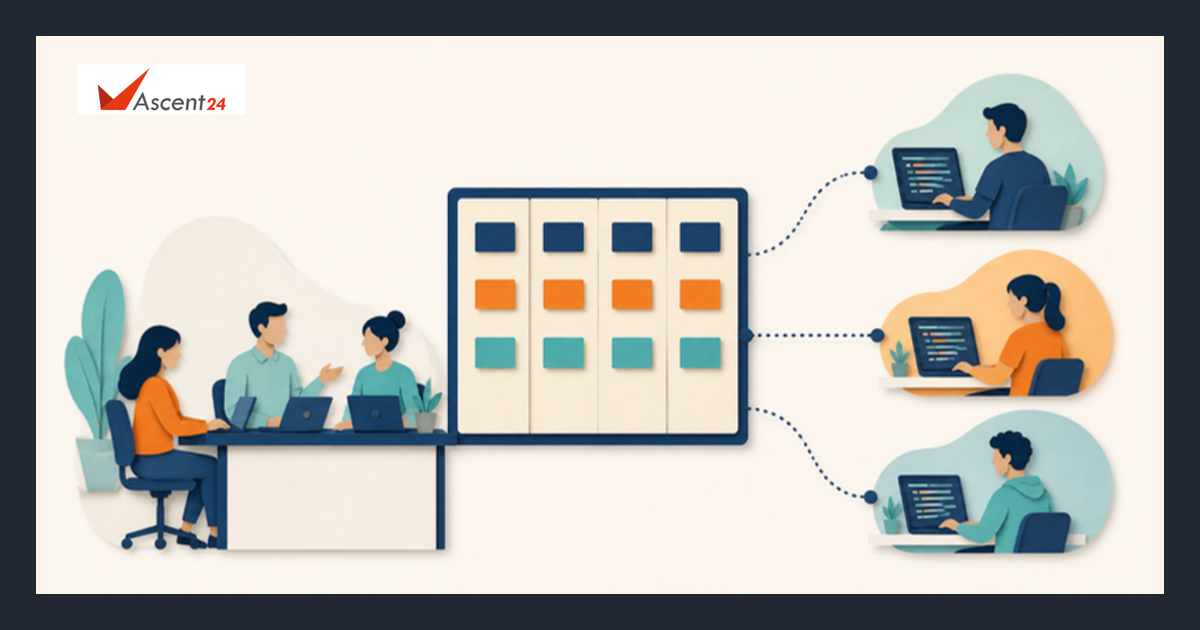
Staff augmentation adds outside developers to your existing team. They join your standups, use your tools and follow your review rules. It is the fastest way to add a skill such as React, Flutter, Node.js or cloud work, but only if someone on your side has time to lead them.
A dedicated team is a group, often developers, QA and a lead, that works only on your product. You keep a product owner who decides what gets built and in what order. It suits a SaaS product or customer app with a long backlog.
Project outsourcing means agreeing a defined outcome, such as a booking portal or a store-to-ERP integration, and letting the vendor manage delivery. It is easy to budget when requirements are clear, and painful when they change weekly, because each change becomes a negotiation.
A quick way to decide
- Can someone on your side own the backlog and accept or reject work every week? If not, lean towards project outsourcing with clear milestones.
- Will the work run for more than about six months? As a rough rule of thumb, longer work favours a dedicated team over rotating contractors.
- Do you already have code review, automated tests and a deployment pipeline? If yes, augmentation slots in quickly. If not, have these set up first.
- How stable is the scope? Stable scope suits a fixed project. Changing scope suits time-based models.
What to prepare before anyone starts
- Write down the goal, the users and what "done" means for the first milestone. In the same survey, 85% named project goals or requirements as the most important context for AI assistants and agents, so one clear brief helps people and tools.
- Give access to the repository, a test environment and the ticket board, with only the permissions each role needs.
- Record past decisions: why you chose your stack, known problems, and what not to touch.
- Agree review rules: who approves pull requests, which tests must pass, and how releases happen.
Contract terms that protect your code
- IP assignment in writing. In the United States, paying for software does not automatically make you the copyright owner. The US Copyright Office explains that a commissioned work counts as a "work made for hire" only if it fits one of nine listed categories and both sides sign a written agreement. Software on its own is not on that list, so use a written assignment of rights for anyone who is not your employee. Rules differ in the UAE, Saudi Arabia, Singapore and Malaysia, so have a local lawyer review the clause.
- Accounts in your name. Repositories, cloud accounts and domains should belong to your company, with the vendor added as a user.
- Confidentiality and data handling if the team will see customer data.
- Exit and handover: source code, documentation, credentials and a handover period if the contract ends.
- Replacement terms: how quickly a departing developer is replaced, and who pays for the overlap.
If you are still deciding whether to build at all, start with custom software vs off-the-shelf, and see what drives custom software cost before comparing quotes.
Where Ascent24 fits
Ascent24 provides tech experts who join your in-house team and dedicated teams for larger projects, alongside custom software and app development. If you are weighing which model suits your roadmap, we are happy to talk it through.
FAQs
Is staff augmentation cheaper than a dedicated team?
Not always. Per-person rates can be similar, but augmentation needs more of your own leadership time.
Can I move from project outsourcing to a dedicated team later?
Yes. It is common after a first release, when you need ongoing improvements. Put handover terms in the first contract.
Do I own the code a contractor writes?
Only if the contract says so. In the US, get a written assignment of rights, and check local law in other countries.
Sources
- Stack Overflow, 2026 Developer Survey: https://survey.stackoverflow.co/2026/ (methodology: https://survey.stackoverflow.co/2026/methodology)
- Stack Overflow Blog, "The results of the 2026 Developer Survey are here!", 6 Oct 2026: https://stackoverflow.blog/2026/10/06/the-results-of-the-2026-developer-survey-are-here/
- US Copyright Office, Circular 30, Works Made for Hire: https://www.copyright.gov/circs/circ30.pdf